
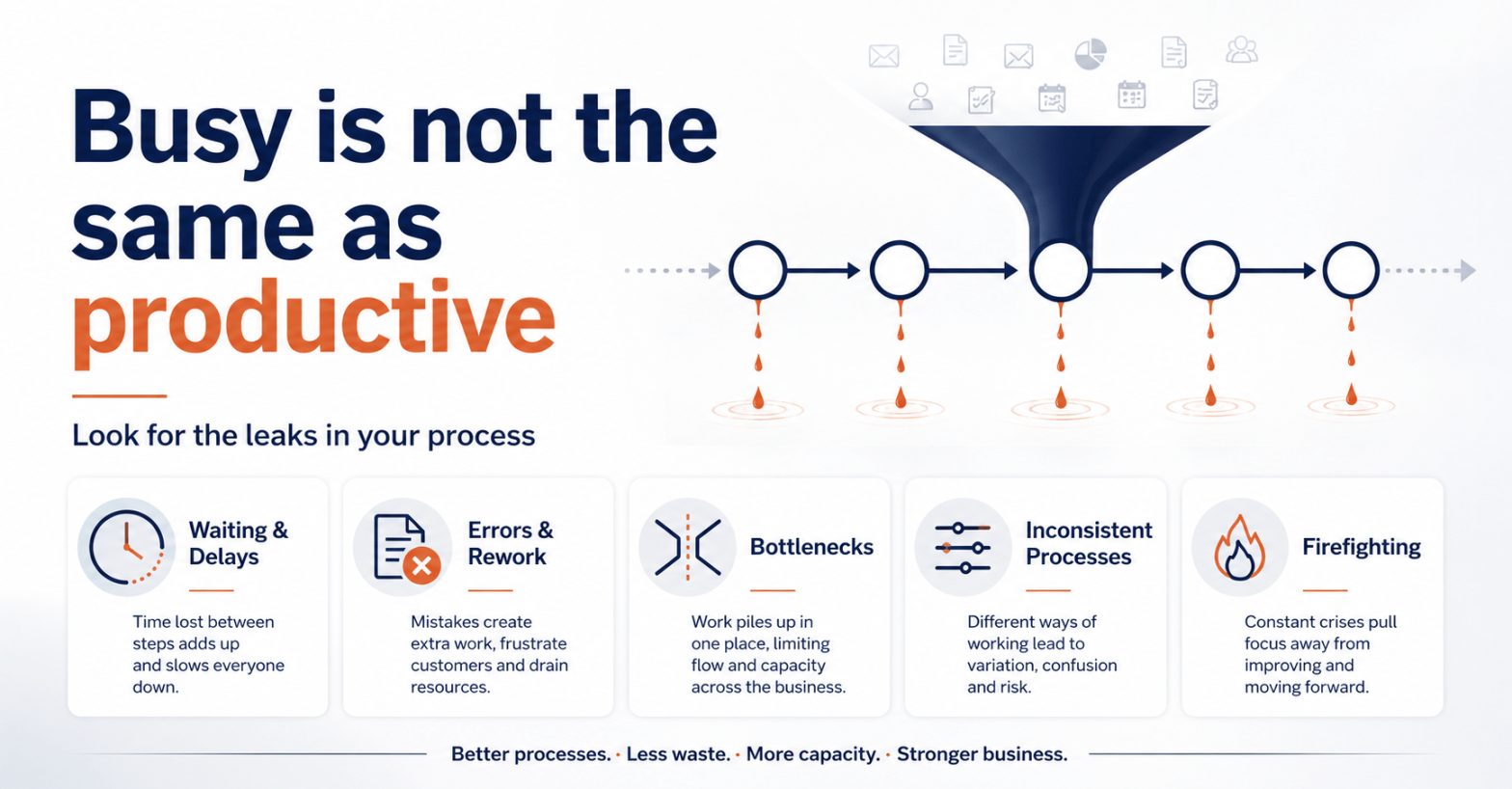
A business can be extremely busy and still be losing a surprising amount of productive capacity.
Phones are ringing. People are working hard. Jobs are moving. Customers are waiting. Managers are solving problems all day.
From the outside, it can look productive.
But busyness and productivity are not the same thing.
Productivity is really about how much useful output we create from the resources we use — our people, time, equipment, systems and effort.
The important question is not simply:
How hard are people working?
It is:
How much of that effort is actually creating value?
Where does productive capacity disappear?
In many businesses, capacity is quietly consumed by things that have simply become part of the day-to-day routine.
Waiting for information.
Chasing approvals.
Correcting mistakes.
Redoing work.
Working around bottlenecks.
Searching for documents.
Following up on missing details.
Dealing with unclear priorities.
Responding to the latest urgent issue.
None of these activities necessarily look dramatic. In fact, after a while, they often become accepted as just the way the business works.
That is where one of the biggest productivity problems can develop.
What was once seen as frustrating or inefficient gradually becomes the new normal.
People stop questioning it.
They develop workarounds.
They get faster at coping with the problem rather than removing the cause.
And because everyone is busy, it can be difficult to step back and ask whether the process itself is working well.
Five common productivity leaks
There are five recurring issues I often see in businesses.
1. Waiting and delays
Work sits waiting for people, approvals, materials, information or decisions.
The delay may not look significant in isolation, but repeated across a process it can consume days of lead time and create frustration for both employees and customers.
2. Errors and rework
Mistakes mean work has to be corrected, repeated or checked again.
Rework is particularly damaging because the business is effectively doing the same job twice for the same result.
It consumes labour, materials and capacity without creating additional value.
3. Bottlenecks
One person, machine, approval or process step becomes the point everything else queues behind.
The rest of the organisation may appear busy, but overall flow is being constrained by one part of the process.
4. Inconsistent processes
Results depend on who happens to be doing the work.
Different people use different methods, information is recorded differently, and quality or lead time varies unnecessarily.
This often creates extra checking and reliance on a few experienced individuals who know how things really work.
5. Firefighting and unclear priorities
Planned work is repeatedly interrupted by urgent problems.
Managers become involved in routine decisions, priorities constantly change, and recurring issues are fixed temporarily rather than properly resolved.
Firefighting can make an organisation feel energetic and responsive, while quietly destroying productivity.
Poor quality is also a productivity problem
Quality and productivity are often treated as separate topics, but in practice they are closely connected.
Poor quality usually creates:
Rework → Delays → Extra cost → Customer frustration
A quality problem may show up in the numbers as:
- customer complaints
- returns or credits
- overtime
- extra freight
- missed delivery dates
- increased material usage
- falling gross margin
- low first-time-right performance
This is why gross margin can sometimes be an early warning sign.
The P&L may tell you that margin is deteriorating.
Operational and quality measures should help tell you why.
A useful question for any business is:
What does getting it wrong actually cost us?
That includes not only scrap and replacement materials, but also:
- the labour used to correct the problem
- management time
- lost productive capacity
- customer recovery
- delays to other work
If time, money or capacity is repeatedly being used to correct work that should have been right the first time, there is a quality problem whether or not the business currently measures it as one.
Look beneath the symptom
Another common mistake is jumping too quickly from a visible problem to a solution.
For example:
“We have delays, therefore we need more people.”
Maybe.
But perhaps the actual cause is:
- incomplete information
- too many approvals
- poor scheduling
- uneven workload
- unclear ownership
- work being released before it is ready
The leak is what we can see.
The cause is often somewhere underneath it.
Before deciding what to change, it is worth asking:
- Where exactly does the problem occur?
- How often does it happen?
- What happens immediately before it?
- What information, decision or resource is missing?
- Is it a one-off issue or a recurring pattern?
- What evidence do we have about the cause?
This is where continuous improvement becomes valuable.
Continuous improvement is a mindset
For me, continuous improvement has always been more of a mindset than a toolkit.
It is about never being completely satisfied with the status quo.
Not because everything is bad or needs changing, but because there is nearly always a better way of doing something.
And even if a process is working well today, the world around the business does not stand still.
Customer expectations change.
Regulations change.
Technology changes.
Competitors change.
People and capability change.
Change really is the constant.
The question is whether a business simply reacts each time something changes, or whether it develops the habit and capability to adapt and improve continuously.
That means:
- questioning the status quo
- involving the people who do the work
- testing small changes
- checking whether they help
- making successful improvements part of normal work
Productivity improvement should not be a one-off cost-cutting exercise.
It should be part of how the business learns and improves.
Where digital tools and AI fit
Digital tools and AI can help, but they should not be the starting point.
The bigger opportunity is not simply getting AI to draft emails or summarise meetings.
It is looking at larger business processes such as:
- enquiry to quote
- quote to order
- order to cash
- purchasing and replenishment
- scheduling
- customer complaints
- quality management
- maintenance
- management reporting
The key principle is simple:
Do not automate waste.
Understand the process first.
Remove unnecessary steps.
Simplify handoffs.
Clarify decisions.
Then decide where digital tools or AI can reduce routine effort, improve information flow or support better decisions.
Technology should support the process.
It should not become the process.
Start with one recurring problem
Improvement does not have to begin with a major programme.
A practical starting point is to choose one recurring problem and measure:
- how often it happens
- how much time it consumes
- what it costs
- what impact it has on the customer
Then observe the process, identify what is really happening, and test one small improvement.
Small and real often beats big and vague.
The most useful question may simply be:
What is getting in the way of people doing good work?
That is often where the first productivity opportunity sits.

