
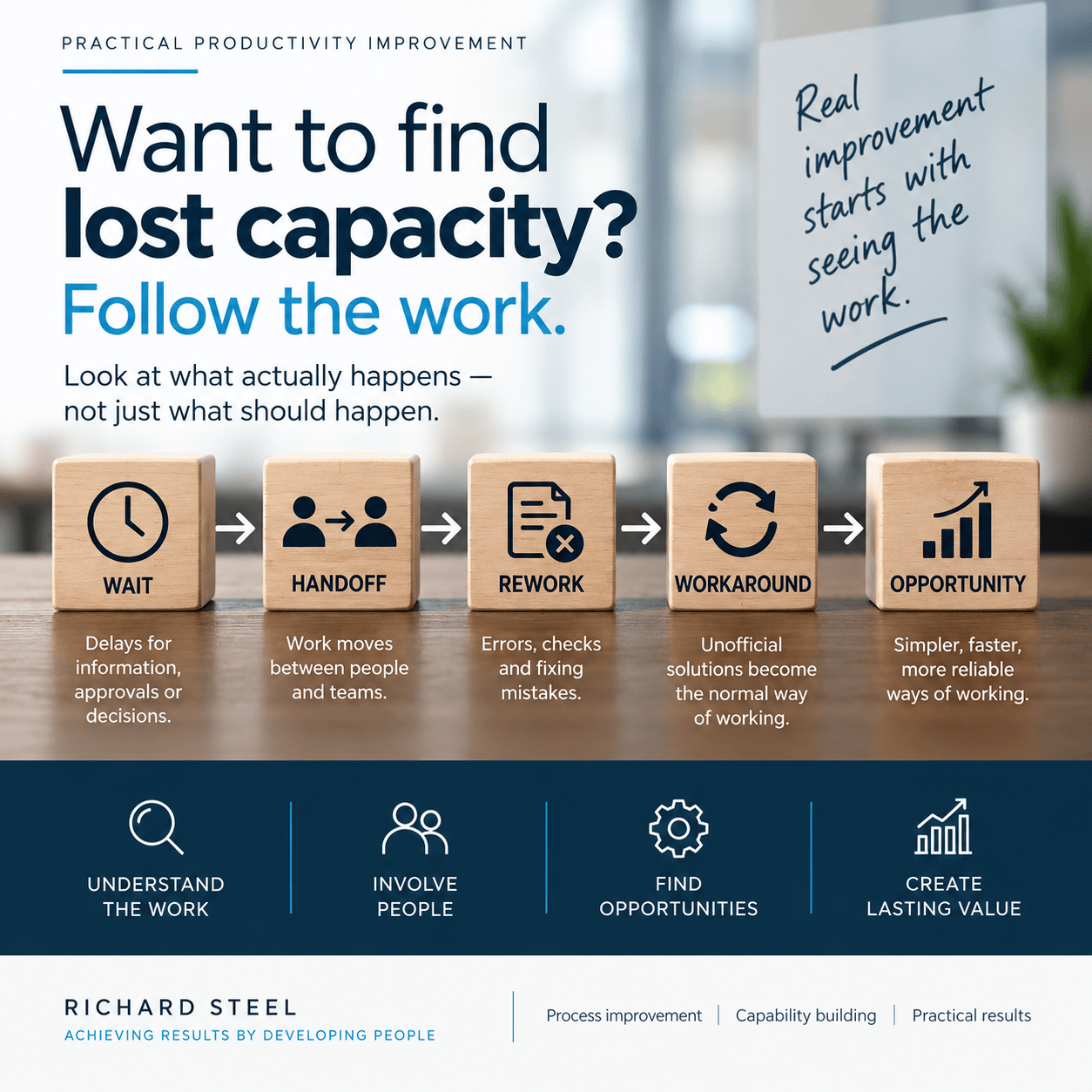
Productivity problems are rarely caused by people simply not working hard enough. More often, performance is lost through the way work is organised — unclear priorities, poor flow, unnecessary handoffs, waiting, rework, weak measures and processes that have simply evolved over time.
In many organisations, these losses become normal. Teams work around them, managers compensate for them, and additional effort is used to keep things moving. The result can be plenty of activity without a corresponding improvement in output, quality or customer experience.
Five common places productivity gets lost
1. Unclear priorities
When everything is important, teams spend time switching between tasks, chasing urgent issues and reacting rather than focusing on the work that creates the most value.
2. Waiting and handoffs
Work often slows between people, teams or systems. Approvals, missing information, unclear ownership and queues can add more delay than the task itself.
3. Rework and quality problems
Errors, corrections and repeated checking consume capacity without creating additional value. Improving quality at source is often one of the quickest ways to improve productivity.
4. Poor visibility of performance
If measures are unclear, delayed or disconnected from the work, teams struggle to see where performance is being lost or whether changes are actually helping.
5. Processes that have simply evolved
Many processes grow through years of workarounds, new systems and added controls. Periodically stepping back and asking “why do we do it this way?” can expose surprisingly large opportunities.
What leaders can do about it
The starting point is not another initiative or more pressure on the team. It is to make the work visible, understand where performance is being lost and focus improvement effort on the few issues that matter most.
That might mean simplifying a process, reducing handoffs, improving measures, addressing recurring quality problems or giving teams clearer priorities. The aim is to remove friction from the work rather than simply asking people to do more.
A practical place to start
A useful first step is to choose one area where performance is frustrating people, customers or leaders and look at the work as it actually happens. Map the process, identify the main sources of delay, rework or confusion, and agree a small number of changes to test.
Good productivity improvement is rarely about a single tool. It is about understanding the work, involving the people closest to it and making changes that produce measurable, sustainable results.

