There is something very human about the way recurring operational problems become normal.
When a process first starts causing frustration, people notice it.
They complain about having to chase information. They question why another spreadsheet is needed. They get irritated by repeated rework, poor handovers, changing schedules or having to enter the same information twice.
But if the problem isn’t fixed, something gradually changes.
People adapt.
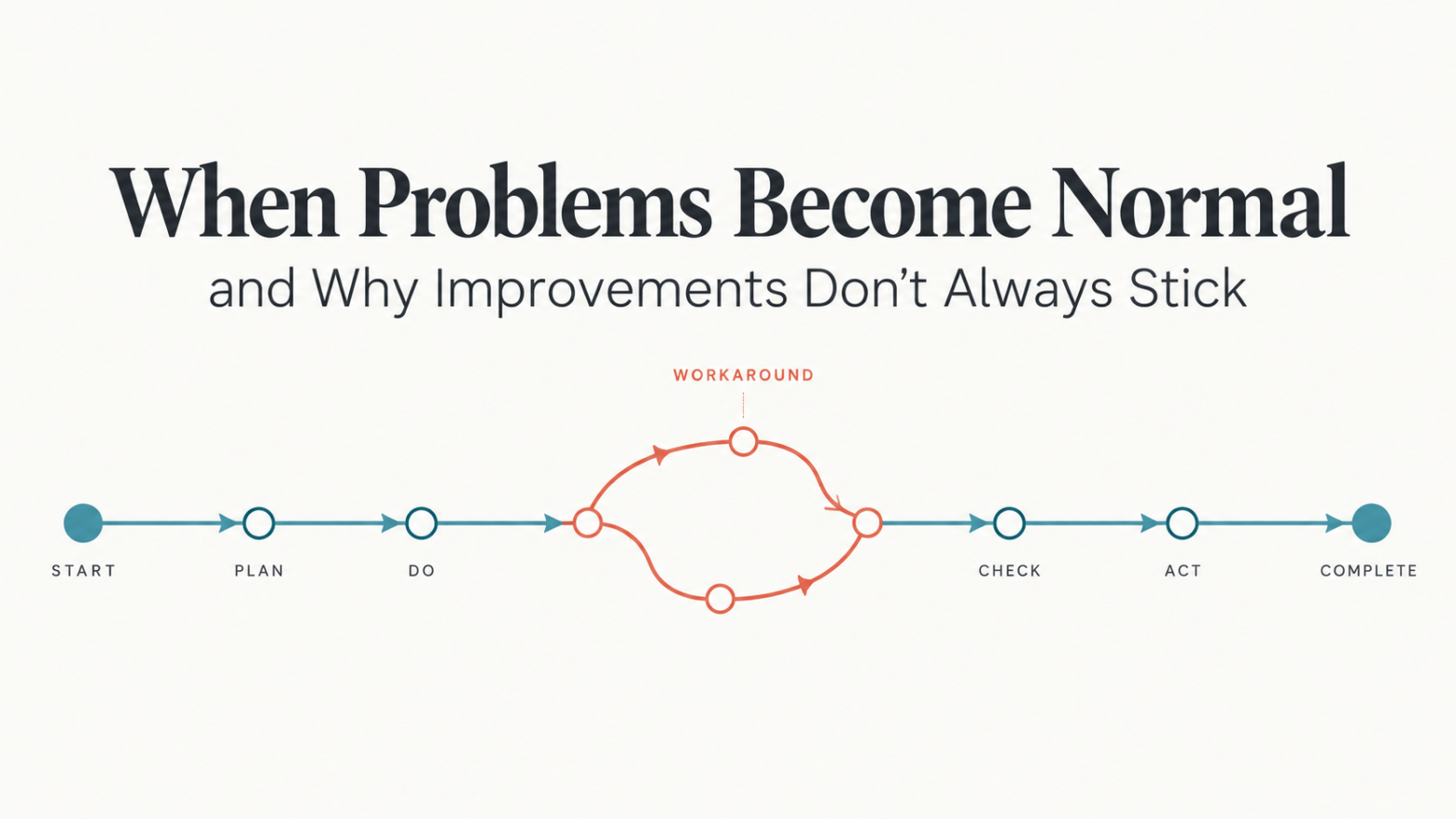
The spreadsheet becomes part of the process. Chasing someone becomes part of the job. The extra quality check becomes standard practice. The workaround gets explained to the next person and, eventually, it stops being seen as a workaround at all.
In a sense, people have to do this.
It would be exhausting to remain frustrated every day by something you feel unable to change. So we absorb the problem and begin to say:
“That’s just how we do it here.”
The problem hasn’t disappeared.
The frustration has.
And that can make the problem surprisingly difficult to see.
When the workaround becomes the process
One of the challenges in improvement work is that the people closest to a process may no longer describe these activities as problems.
They simply describe how the work is done.
Someone regularly chases missing information.
Another person maintains a spreadsheet because two systems don’t talk to each other.
An experienced employee knows which jobs need to be moved to the front of the queue.
Someone else performs an additional check because they have learned not to trust what arrives from the previous step.
Individually, these things may seem relatively insignificant.
Collectively, they consume capacity, create delays, increase dependence on particular people and make the organisation harder to run.
This is often where a fresh pair of eyes can help.
Not because someone from outside automatically knows the answer, but because they are more likely to ask:
Why do we do that?
What happens if we don’t?
How often does this occur?
What problem is this workaround actually compensating for?
Why people can resist fixing something they dislike
There is another interesting human factor at work.
We rely heavily on habits and routines. Familiarity reduces the amount of conscious effort required to get through the day.
That is useful.
The difficulty comes when an organisation asks people to change something that has become familiar.
Even if the existing process is frustrating, people have learned how to operate within it. They know the shortcuts. They know which spreadsheet to open, who to call, what to check and how to recover when something goes wrong.
A new process may ultimately be better, but initially it removes some of that certainty.
That means people can find themselves in the apparently contradictory position of defending a process they previously complained about.
It is tempting to label that as “resistance to change”.
I think it is more useful to understand what sits behind it.
People are being asked to give up something they know how to navigate and replace it with something they do not yet fully trust.
That is why sustainable improvement needs more than a technically better process. People need to understand why the change is necessary, be involved in shaping it and have the opportunity to become confident in the new way of working.
Change is not finished when it goes live
There is another reason improvements fail to stick.
Organisations often treat implementation as the finish line.
They do some planning, introduce the new process and then move on to the next priority.
In PDCA terms, there is usually plenty of Plan and Do, but often much less Check and Act.
I sometimes prefer to think of that final step as Adjust.
It is unusual to get a change exactly right first time.
Once people start using a new process, they learn things that could not have been predicted during the design stage.
Responsibilities may need clarifying.
A form may need changing.
A measure may not tell us what we expected.
Training gaps appear.
And some processes simply need time before they can be judged properly.
A month-end billing process may need to go through several month ends. A sales process may need to move through several customer cycles. A production or scheduling change may need to experience different levels of demand.
That is why I like a simple 30–60–90 day review.
At 30 days: What is working and what is getting in the way?
At 60 days: Is the new way becoming normal, and are the measures moving in the right direction?
At 90 days: Have we achieved the result we expected, what still needs adjusting, and what have we learned?
That follow-up may lead to further training, updated standard operating procedures, clarified responsibilities, lessons learned or another small adjustment to the process.
It is also the point at which we should ask whether the expected return on the improvement has actually been achieved.
Implementation is an event. Improvement is a cycle.
Making improvement stick
Sustainable improvement therefore involves more than identifying waste or designing a better process.
We have to recognise how people adapt to poor processes, understand why familiar ways of working can be difficult to give up, and continue supporting a change after it has been introduced.
That is why I have always believed that achieving results and developing people belong together.
Good improvement leaves the organisation with more than a better process.
It leaves people better able to recognise problems, test changes, learn from results and continue improving after the initial intervention has finished.
Sometimes the starting point is surprisingly simple: Notice something the organisation has learned to live with — and ask whether it really needs to stay that way.
Got a recurring operational problem that won’t go away?
I’m currently offering Nelson Tasman businesses a complimentary 60-minute Problem Review: one problem, one hour and a fresh pair of eyes.

